
01 April 2026





E - Environment
E1: Climate Change Management
|  |
The hospital is committed to achieving Carbon Neutrality by 2050. It applies greenhouse gas (GHG) mitigation and climate change adaptation approaches within the hospital context through GHG emissions data management, the setting of GHG reduction targets and measures, improved energy and resource efficiency, and the assessment and management of risks from disasters and climate change, together with raising employee awareness of environmentally responsible operations.
◆Greenhouse Gas Emissions
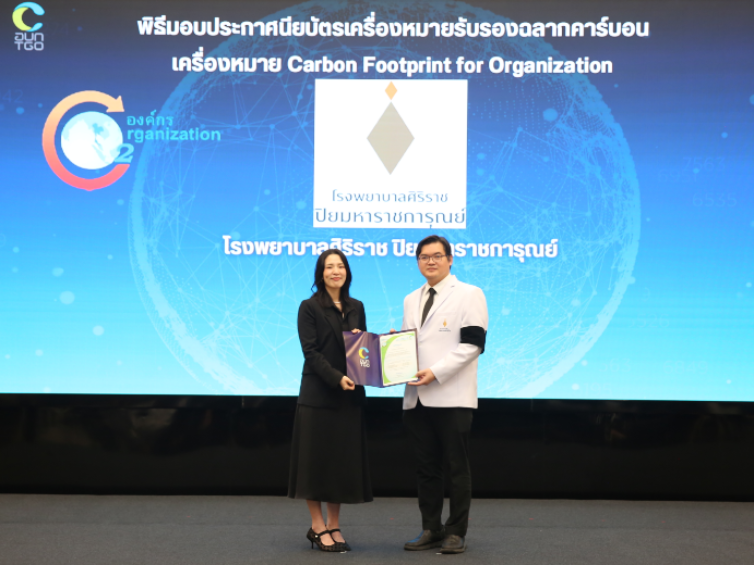
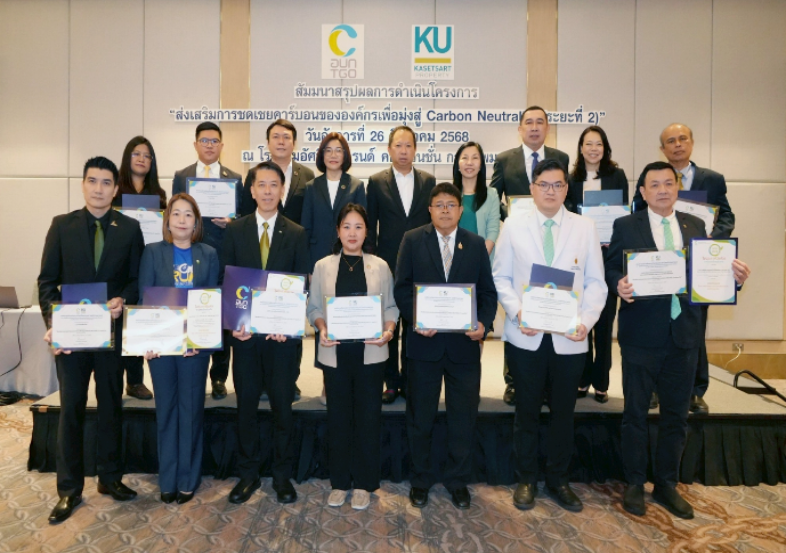
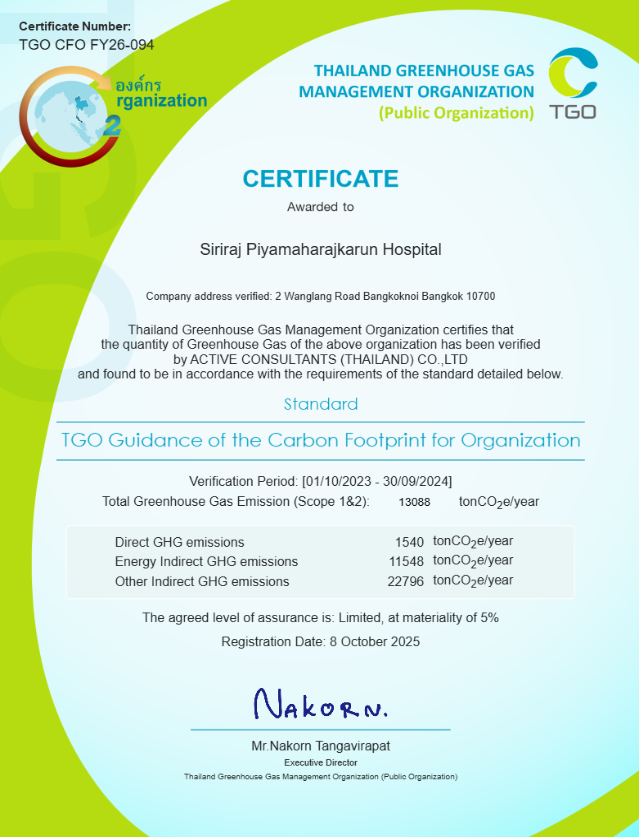
The hospital has developed its Carbon Footprint for Organization (CFO), covering all three scopes (Scope 1, Scope 2 and Scope 3). Data was first reported in 2024 (B.E. 2567) and has continued on an ongoing basis. GHG emissions are assessed in accordance with the guidelines of the Thailand Greenhouse Gas Management Organization (Public Organization), or TGO, and have been verified by an independent external verifier registered with TGO.
Year 2024
35,884 tCO₂e
Total Greenhouse Gas Emissions (Scope 1+2+3)
Scope 1
1,540 4.29%
Scope 2
11,548 32.18%
Scope 3
22,796 63.53%
Scope 1+2: 13,088 tCO₂e
Carbon Intensity (S1+2): 0.0141 tCO₂e/คน
Carbon Intensity (S1+2+3): 0.0387 tCO₂e/คน
Year 2025
43,098 tCO₂e
Total Greenhouse Gas Emissions (Scope 1+2+3)
Scope 1
1,595 3.70%
Scope 2
11,495 26.67%
Scope 3
30,008 69.63%
Scope 1+2: 13,090 tCO₂e
Carbon Intensity (S1+2): 0.0133 tCO₂e/คน
Carbon Intensity (S1+2+3): 0.0436 tCO₂e/คน
◆Greenhouse Gas Offsetting
The hospital recognizes that medical services must operate continuously, 24 hours a day, and depend on secure and reliable energy and utility systems to maintain the quality of care and patient safety, for example air-conditioning and ventilation, electrical power, medical equipment, operating rooms, information systems, laboratories, and other clinical support systems. Energy reduction must therefore be pursued in step with maintaining the quality, safety, and continuity of medical services.
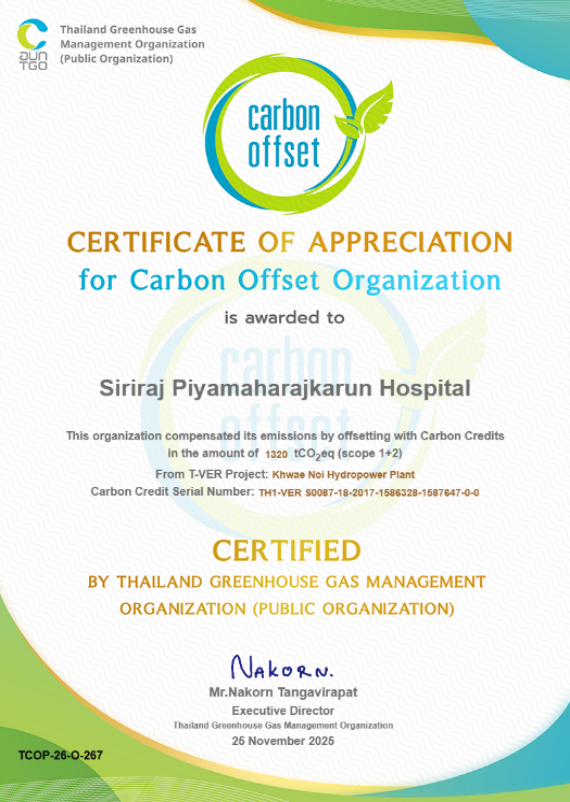
Accordingly, the hospital applies the principle of “Reduce First, Offset Residual Emissions”, continually implementing energy and resource efficiency measures while giving priority to safety and its clinical mission. Where residual GHG emissions cannot be reduced immediately or in full owing to technical constraints, system reliability requirements, and the need to deliver medical services, the hospital applies Carbon Offsetting as a supplementary measure. Offsetting is carried out by procuring carbon credits from standards-based, traceable projects, namely T-VER (Thailand Voluntary Emission Reduction Program) projects under TGO's offsetting scheme.
 |  |
 |  |
E2: Energy Management
|  |
Energy is a key resource for hospital operations and medical services, particularly electrical power, HVAC, water production and supply systems, medical support systems, and the utilities needed to deliver services around the clock. Effective energy management therefore plays an important role in reducing resource use, lowering costs, cutting greenhouse gas emissions, and improving the hospital's operating efficiency in a sustainable way.
Efficient energy use is a core element of the hospital's approach to reducing greenhouse gas emissions. The hospital encourages personnel at all levels to build knowledge and awareness of energy efficiency and to take part in reducing energy use in their work areas, for example by using electrical equipment and air-conditioning appropriately, switching off equipment when not in use, and proposing ideas or projects to improve energy efficiency, in order to foster an organizational culture of using resources wisely.
◆Installation of High-Efficiency LED Lighting
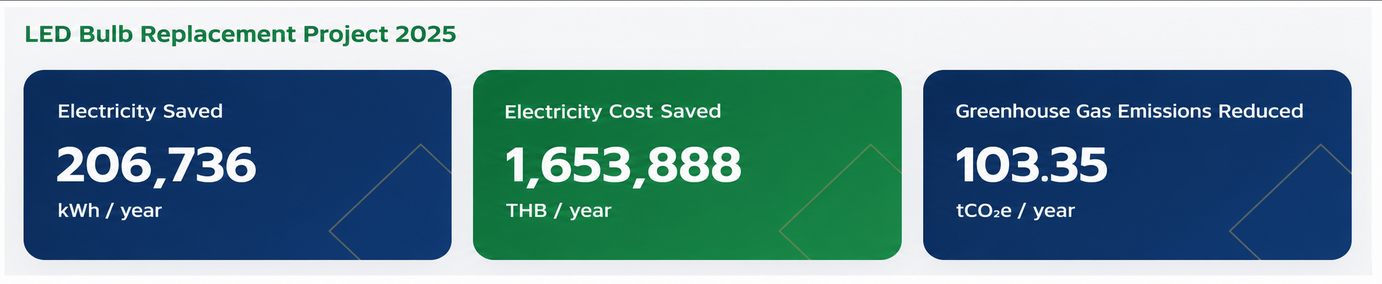
Floors 1–6, Zones A and C: replaced 400 FL 36W fluorescent tubes with 18W LED tubes
Replaced 200 18W compact fluorescent lamps with 7W LED bulbs
Replaced 200 18W compact fluorescent lamps with 15W LED panel lights
◆Energy-Saving Campaign
Encourages personnel to change their electricity-use behavior in daily life and in their work areas, for example switching off lights and electrical appliances when not in use, shutting down computers and office equipment after use, using air-conditioning appropriately, keeping room doors fully closed while air-conditioning is running, and avoiding the unnecessary use of electrical equipment. Communication and publicity through various channels help personnel understand and take part in continually reducing energy use.
E3: Waste Management
|  |
The hospital places importance on systematic waste management across the entire life cycle, from preventing waste at source, segregation, and collection, through reuse or recycling, to transport and disposal appropriate to each waste type and the applicable requirements, while safeguarding the safety of patients, service users, personnel, and waste-handling workers and limiting impacts on the community and the environment.
Operations cover waste generated by medical services and hospital activities, namely general waste, infectious waste, recyclable waste, hazardous waste, and other waste requiring special handling. Segregation and storage practices are defined to suit the characteristics of each waste type, in order to prevent cross-contamination, reduce exposure risk, and maximize the recovery of resources.
The hospital gives first priority to preventing and reducing waste, together with the efficient use of resources. It promotes the reuse of materials, segregation for recycling, and the recovery of waste with utilization potential, such as the management of food waste and recyclable materials, to reduce the volume of waste sent for final disposal as well as resource consumption and environmental impact.
◆Recyclable Material Segregation
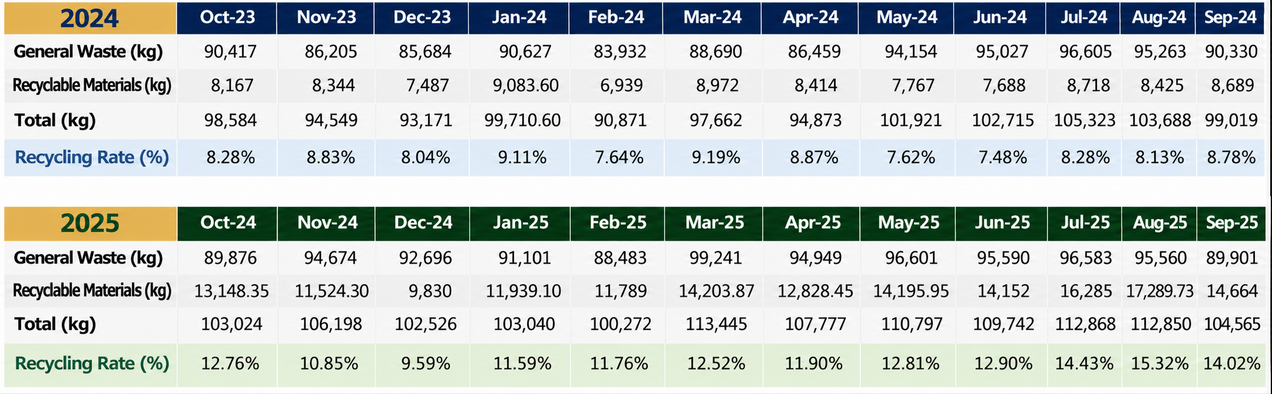
The hospital promotes resource management in line with the Circular Economy concept, aiming to reduce the volume of waste requiring disposal and increase the share of materials that can be recovered. This is delivered through a recyclable waste segregation and recovery project run in partnership with Wake Up Waste, a collaboration that systematically manages recyclable materials from source through to their return into the recycling process. In fiscal year 2025 (B.E. 2568), the hospital segregated 162 tonnes of recyclable waste, reducing greenhouse gas emissions by 128 tCO2e.
◆Waste Management Performance
◆Food Waste Segregation for Delivery to Farmers
The hospital places importance on reducing food waste as part of waste management and the efficient use of resources, and promotes segregating food scraps from general waste at source.
The hospital runs a project that segregates food scraps from general waste and passes them on to farmers. Food scraps generated by food service operations and activities within the hospital are collected, separated from other waste types, and stored appropriately before being delivered to farmers for use in agricultural processes as appropriate, for example as input for organic matter management or for animal feeding in line with defined guidelines.
The project reduces the volume of food scraps that would otherwise be disposed of together with general waste, lowers the burden and cost of waste management, and allows still-useful organic resources to be put to use rather than discarded as waste. It also reduces the contamination of food scraps with other waste types, which affects the efficiency of segregation and material recovery. In fiscal year 2025 (B.E. 2568), 164 tonnes of food scraps were segregated, reducing greenhouse gas emissions by 130 tCO2e.
E4: Water Management
|  |
Water is a critically important resource for hospital operations, as it is used in medical service delivery, patient care, cleaning and disinfection, sanitation systems, air-conditioning, food preparation, and various support activities. The hospital therefore prioritizes efficient water management, to ensure sufficient supply for services while reducing unnecessary use and losses and preventing environmental impacts.
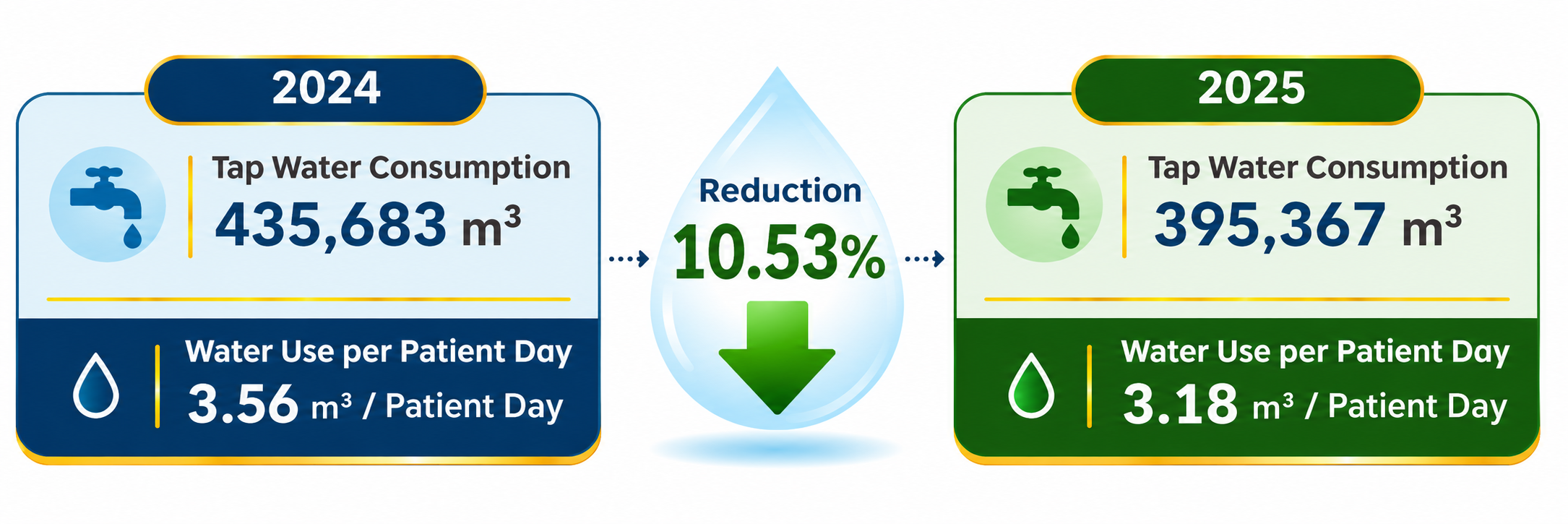
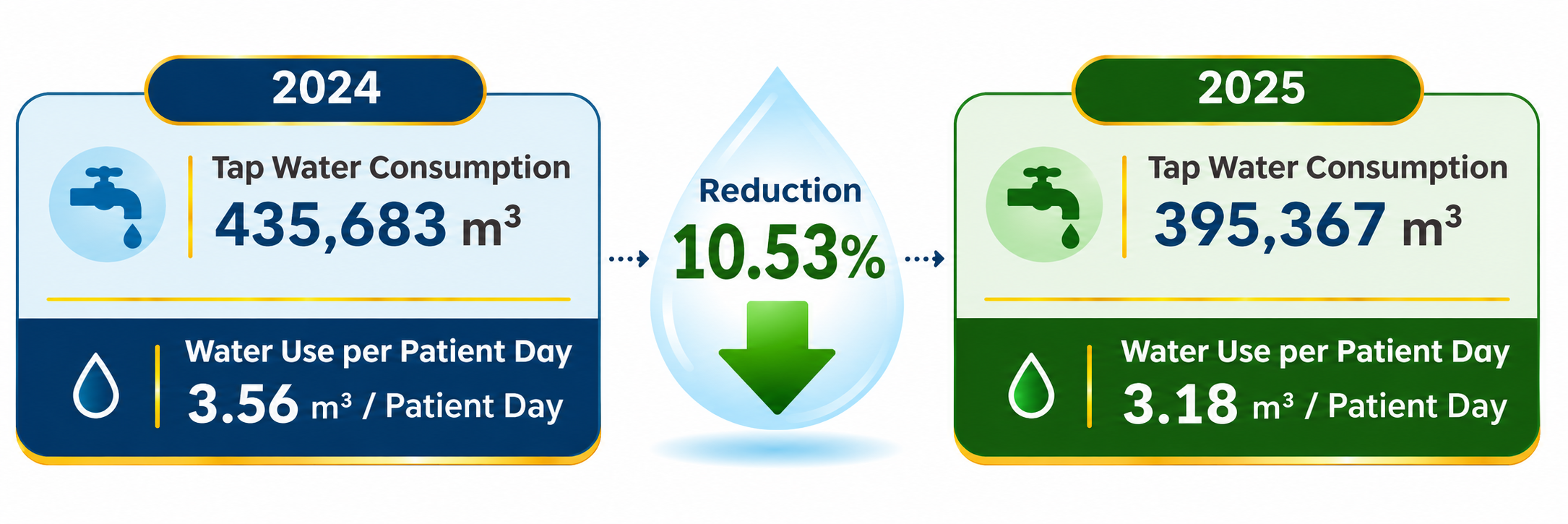
The hospital continually monitors and analyzes water consumption to understand usage patterns, identify high-consumption points, and define appropriate efficiency measures. It considers both total water consumption and Water Intensity relative to the scale and activity of services, for example water consumption per patient day, to track trends and evaluate the effectiveness of water-reduction measures.
The hospital promotes the wise use of water resources by regularly inspecting and maintaining the water supply system and monitoring for leaks to prevent unnecessary water loss. It also raises personnel awareness and encourages participation in using water appropriately and reducing behaviors that cause unnecessary water use. For wastewater management, the hospital places importance on controlling the quality of effluent from its operations, with systems to collect and treat wastewater before it is discharged to the environment, and it monitors water quality against applicable criteria and requirements to prevent impacts on water bodies, the community, and surrounding ecosystems.
◆Water Management
01
Water Use Monitoring and Analysis
Continually collects water consumption data, analyzes trends, and develops Water Intensity metrics to inform efficiency measures.
02
Reducing Water Use and Losses
Promotes economical water use, inspects the water supply system and related equipment, and detects and fixes leaks promptly.
03
Wastewater Management
Controls and treats wastewater from various activities before discharge to the environment, monitors water quality, and maintains the treatment system so that it operates efficiently. In 2025 (B.E. 2568), 100% of wastewater from hospital buildings was treated and effluent quality monitoring met the standard criteria, and the hospital received no reports or complaints from any external agency or other party concerning violations of, or non-compliance with, water quality management standards or regulations.
04.
Personnel Engagement
Communicates and campaigns to make personnel aware of the value of water resources, and to encourage them to take part in reducing water use and to report abnormalities or leaks.
E1: Climate Change Management
| |
The hospital is committed to achieving Carbon Neutrality by 2050. It applies greenhouse gas (GHG) mitigation and climate change adaptation approaches within the hospital context through GHG emissions data management, the setting of GHG reduction targets and measures, improved energy and resource efficiency, and the assessment and management of risks from disasters and climate change, together with raising employee awareness of environmentally responsible operations.
◆Greenhouse Gas Emissions
The hospital has developed its Carbon Footprint for Organization (CFO), covering all three scopes (Scope 1, Scope 2 and Scope 3). Data was first reported in 2024 (B.E. 2567) and has continued on an ongoing basis. GHG emissions are assessed in accordance with the guidelines of the Thailand Greenhouse Gas Management Organization (Public Organization), or TGO, and have been verified by an independent external verifier registered with TGO.
Year 2024
35,884 tCO₂e
Total Greenhouse Gas Emissions (Scope 1+2+3)
Scope 1
1,540 4.29%
Scope 2
11,548 32.18%
Scope 3
22,796 63.53%
Scope 1+2: 13,088 tCO₂e
Carbon Intensity (S1+2): 0.0141 tCO₂e/คน
Carbon Intensity (S1+2+3): 0.0387 tCO₂e/คน
Year 2025
43,098 tCO₂e
Total Greenhouse Gas Emissions (Scope 1+2+3)
Scope 1
1,595 3.70%
Scope 2
11,495 26.67%
Scope 3
30,008 69.63%
Scope 1+2: 13,090 tCO₂e
Carbon Intensity (S1+2): 0.0133 tCO₂e/คน
Carbon Intensity (S1+2+3): 0.0436 tCO₂e/คน
◆Greenhouse Gas Offsetting
The hospital recognizes that medical services must operate continuously, 24 hours a day, and depend on secure and reliable energy and utility systems to maintain the quality of care and patient safety, for example air-conditioning and ventilation, electrical power, medical equipment, operating rooms, information systems, laboratories, and other clinical support systems. Energy reduction must therefore be pursued in step with maintaining the quality, safety, and continuity of medical services.
Accordingly, the hospital applies the principle of “Reduce First, Offset Residual Emissions”, continually implementing energy and resource efficiency measures while giving priority to safety and its clinical mission. Where residual GHG emissions cannot be reduced immediately or in full owing to technical constraints, system reliability requirements, and the need to deliver medical services, the hospital applies Carbon Offsetting as a supplementary measure. Offsetting is carried out by procuring carbon credits from standards-based, traceable projects, namely T-VER (Thailand Voluntary Emission Reduction Program) projects under TGO's offsetting scheme.
| |
| |
E2: Energy Management
| |
Energy is a key resource for hospital operations and medical services, particularly electrical power, HVAC, water production and supply systems, medical support systems, and the utilities needed to deliver services around the clock. Effective energy management therefore plays an important role in reducing resource use, lowering costs, cutting greenhouse gas emissions, and improving the hospital's operating efficiency in a sustainable way.
Efficient energy use is a core element of the hospital's approach to reducing greenhouse gas emissions. The hospital encourages personnel at all levels to build knowledge and awareness of energy efficiency and to take part in reducing energy use in their work areas, for example by using electrical equipment and air-conditioning appropriately, switching off equipment when not in use, and proposing ideas or projects to improve energy efficiency, in order to foster an organizational culture of using resources wisely.
◆Installation of High-Efficiency LED Lighting
Floors 1–6, Zones A and C: replaced 400 FL 36W fluorescent tubes with 18W LED tubes
Replaced 200 18W compact fluorescent lamps with 7W LED bulbs
Replaced 200 18W compact fluorescent lamps with 15W LED panel lights
◆Energy-Saving Campaign
Encourages personnel to change their electricity-use behavior in daily life and in their work areas, for example switching off lights and electrical appliances when not in use, shutting down computers and office equipment after use, using air-conditioning appropriately, keeping room doors fully closed while air-conditioning is running, and avoiding the unnecessary use of electrical equipment. Communication and publicity through various channels help personnel understand and take part in continually reducing energy use.
E3: Waste Management
| |
The hospital places importance on systematic waste management across the entire life cycle, from preventing waste at source, segregation, and collection, through reuse or recycling, to transport and disposal appropriate to each waste type and the applicable requirements, while safeguarding the safety of patients, service users, personnel, and waste-handling workers and limiting impacts on the community and the environment.
Operations cover waste generated by medical services and hospital activities, namely general waste, infectious waste, recyclable waste, hazardous waste, and other waste requiring special handling. Segregation and storage practices are defined to suit the characteristics of each waste type, in order to prevent cross-contamination, reduce exposure risk, and maximize the recovery of resources.
The hospital gives first priority to preventing and reducing waste, together with the efficient use of resources. It promotes the reuse of materials, segregation for recycling, and the recovery of waste with utilization potential, such as the management of food waste and recyclable materials, to reduce the volume of waste sent for final disposal as well as resource consumption and environmental impact.
◆Recyclable Material Segregation
The hospital promotes resource management in line with the Circular Economy concept, aiming to reduce the volume of waste requiring disposal and increase the share of materials that can be recovered. This is delivered through a recyclable waste segregation and recovery project run in partnership with Wake Up Waste, a collaboration that systematically manages recyclable materials from source through to their return into the recycling process. In fiscal year 2025 (B.E. 2568), the hospital segregated 162 tonnes of recyclable waste, reducing greenhouse gas emissions by 128 tCO2e.
◆Waste Management Performance
◆Food Waste Segregation for Delivery to Farmers
The hospital places importance on reducing food waste as part of waste management and the efficient use of resources, and promotes segregating food scraps from general waste at source.
The hospital runs a project that segregates food scraps from general waste and passes them on to farmers. Food scraps generated by food service operations and activities within the hospital are collected, separated from other waste types, and stored appropriately before being delivered to farmers for use in agricultural processes as appropriate, for example as input for organic matter management or for animal feeding in line with defined guidelines.
The project reduces the volume of food scraps that would otherwise be disposed of together with general waste, lowers the burden and cost of waste management, and allows still-useful organic resources to be put to use rather than discarded as waste. It also reduces the contamination of food scraps with other waste types, which affects the efficiency of segregation and material recovery. In fiscal year 2025 (B.E. 2568), 164 tonnes of food scraps were segregated, reducing greenhouse gas emissions by 130 tCO2e.
E4: Water Management
| |
Water is a critically important resource for hospital operations, as it is used in medical service delivery, patient care, cleaning and disinfection, sanitation systems, air-conditioning, food preparation, and various support activities. The hospital therefore prioritizes efficient water management, to ensure sufficient supply for services while reducing unnecessary use and losses and preventing environmental impacts.
The hospital continually monitors and analyzes water consumption to understand usage patterns, identify high-consumption points, and define appropriate efficiency measures. It considers both total water consumption and Water Intensity relative to the scale and activity of services, for example water consumption per patient day, to track trends and evaluate the effectiveness of water-reduction measures.
The hospital promotes the wise use of water resources by regularly inspecting and maintaining the water supply system and monitoring for leaks to prevent unnecessary water loss. It also raises personnel awareness and encourages participation in using water appropriately and reducing behaviors that cause unnecessary water use. For wastewater management, the hospital places importance on controlling the quality of effluent from its operations, with systems to collect and treat wastewater before it is discharged to the environment, and it monitors water quality against applicable criteria and requirements to prevent impacts on water bodies, the community, and surrounding ecosystems.
◆Water Management
01
Water Use Monitoring and Analysis
Continually collects water consumption data, analyzes trends, and develops Water Intensity metrics to inform efficiency measures.
02
Reducing Water Use and Losses
Promotes economical water use, inspects the water supply system and related equipment, and detects and fixes leaks promptly.
03
Wastewater Management
Controls and treats wastewater from various activities before discharge to the environment, monitors water quality, and maintains the treatment system so that it operates efficiently. In 2025 (B.E. 2568), 100% of wastewater from hospital buildings was treated and effluent quality monitoring met the standard criteria, and the hospital received no reports or complaints from any external agency or other party concerning violations of, or non-compliance with, water quality management standards or regulations.
04
Personnel Engagement
Communicates and campaigns to make personnel aware of the value of water resources, and to encourage them to take part in reducing water use and to report abnormalities or leaks.